Amazon FBA Prep Center in Germany: Prep Rules, Labels and Costs
What FBA prep covers, whether Amazon still labels units in Europe, what the service costs and how to choose the right prep centre.

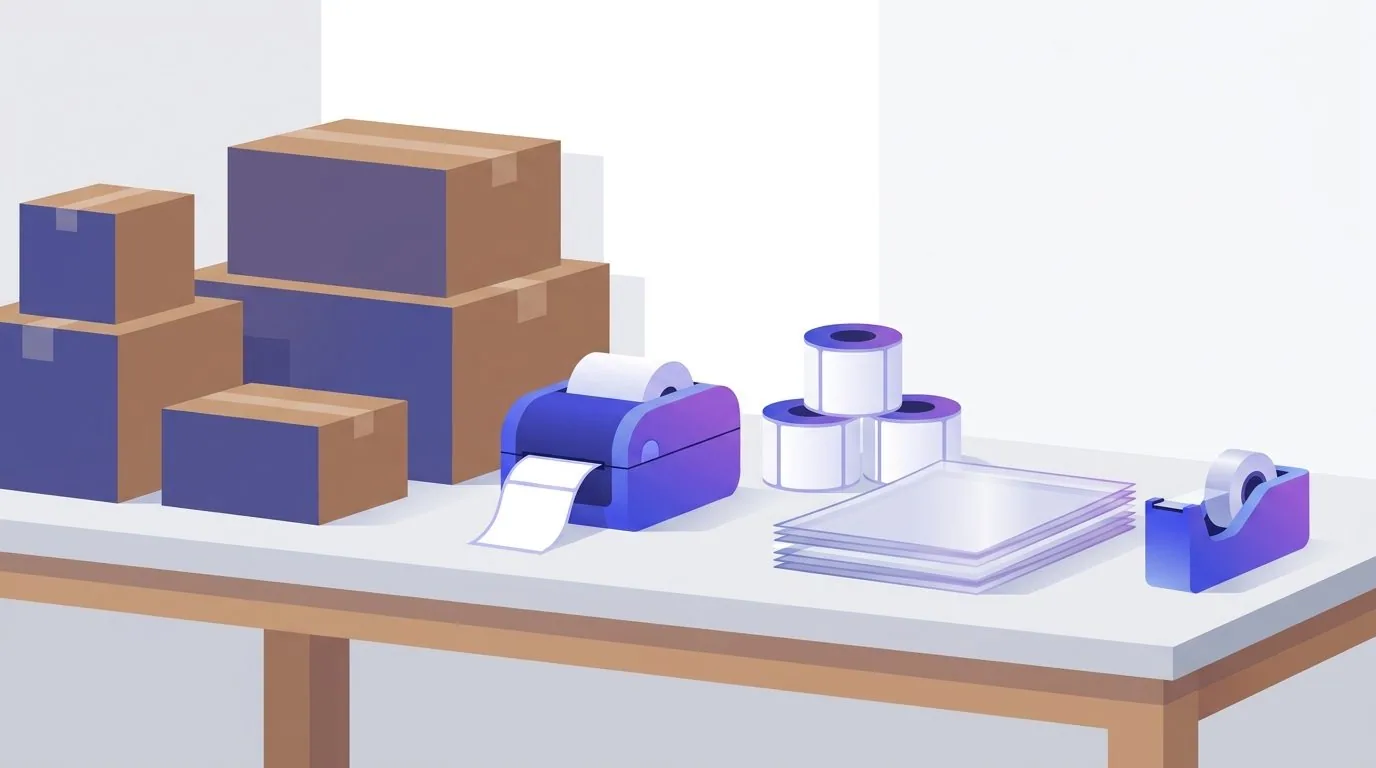
- In the US, Amazon stopped FBA prep and item labelling on 1 January 2026. In the EU, the rate card valid from 1 February 2026 still lists the FBA Prep Service, with labelling from 0.38 euros per unit.
- Prep means labelling every unit clearly, packaging it so it survives storage and shipping, and sending cartons that meet Amazon's weight, size and labelling rules.
- A prep centre pays off when you lack space, time or routine. Choose one by distance to your supplier and Amazon's sites, experience with Send to Amazon, liability terms and a clear price per unit.
Amazon FBA prep: what preparation means
Before your goods are received at an Amazon fulfilment centre, the site must be able to process them without questions. That is what FBA prep means: every unit carries a scannable barcode, is packaged so it survives storage and shipping, and arrives in a carton that meets Amazon's requirements. An Amazon FBA prep center is a service provider that does these steps for you.
Prep is not a formality. Amazon stores millions of items from many sellers, and receiving staff need to match every unit to your inventory in seconds. If a label is missing, a bag is open or a carton is too heavy, the unit is reworked, received later or not accepted at all. That costs you availability, and in the worst case your stock is missing exactly when demand is high.
You have four basic options: do it yourself, have your supplier deliver ready-labelled goods, hire a prep centre, or, in Europe, use Amazon's paid FBA Prep Service. Which one fits depends on your volume, your storage space and how standardised your products are.
Did Amazon end its prep service? The US and Europe compared
Many sellers have read that Amazon ended its prep service. That is true, but only for the US: Amazon announced that from 1 January 2026 it no longer offers prep and item labelling for FBA shipments in the US store. Shipments created before that date were still serviced. Since then, US sellers have to prep themselves or use a service provider.
Europe is different. The Amazon rate card for Europe, valid from 1 February 2026, still lists the FBA Prep Service as an optional service with a fee per unit. It covers labelling, bagging, opaque bagging, bubble wrap and taping. You will find the prices in the cost section below.
What counts is what Seller Central offers for your item when you create a shipment. Amazon can change services and fees with notice, so check the current rate card before any larger plan. If you sell in Germany and also in the US, you need your own prep solution for the US market in any case.
The end of the prep service on 1 January 2026 applies to the US store. For your planning in Germany, the European rate card and what Seller Central shows for your shipment are what matter.
FNSKU, EAN and labelling done right
To match units in the warehouse, Amazon uses the FNSKU. It is different from the ASIN, which describes the product in the catalogue, and from the manufacturer's EAN. How these numbers relate is explained in our guide to the ASIN number. The FNSKU links the unit to your seller account, which keeps your stock separate from identical goods of other sellers.
Whether you can send units with the manufacturer barcode or need an Amazon label is set in your account's barcode preferences, and Amazon checks it for each item. In the US, Amazon ended the pooling of identical goods from different sellers on 31 March 2026, according to an announcement in the US seller forums. Since then, sellers there who do not own the brand need FNSKU labels in particular. If you are not the brand owner, your own FNSKU label is the safe choice in Europe too.
A few simple rules apply to the labelling itself, and many shipments still fail on them. Only one scannable barcode may be visible on each unit. Cover old barcodes completely. The label sits flat on an even surface, not over edges or curves. A thermal printer with matching labels saves you smudged or hard-to-read codes.
Packaging rules: poly bags, sets and fragile items
Which prep Amazon expects for an item is shown when you create a shipment in Send to Amazon. Each item is assigned a prep type there, for example for textiles, liquids, sharp or fragile items. The key basics come up again and again:
- 1Poly bags
Transparent, securely sealed, and either the barcode can be scanned through the bag or it is stuck on the outside. Larger bags need a suffocation warning. The exact thresholds for opening size and film thickness are in the prep guidance in Seller Central.
- 2Sets
What is sold together must stay together. Seal sets firmly and mark them clearly as a set that must not be separated. Cover the individual barcodes of the items inside.
- 3Fragile items
Pad glass, ceramics and sensitive devices so they survive a drop, for example with bubble wrap or a sturdy individual box.
- 4Liquids
Secure the closures and put the item in a sealed bag as well, so nothing leaks if it gets damaged.
- 5Expiry dates
Items with an expiry date need a clearly readable date on the unit and on the carton. Amazon expects enough remaining shelf life on arrival.
Requirements differ by category and are updated over time. What counts is the prep guidance Seller Central shows for your item and your marketplace.
Shipping cartons: weight, size and labels
Besides individual units, Amazon also checks the cartons. In the European seller forums, Amazon staff regularly confirm the key limits: a carton of standard-size items weighs no more than 23 kilograms, and no side is longer than 63.5 centimetres. Exceptions apply to single oversize items. Cartons from 15 kilograms need a heavy package label, visible on top and on the sides, in the language of the destination country.
Each carton gets the FBA box label from your shipping plan, placed so it is not cut when the carton is opened. Also provide the box content information. If it is missing, Amazon processes the carton manually and, according to the rate card, charges a fee of 0.18 euros per unit. Such shipments are also often received more slowly.
Plan cartons with the destination in mind as well. Amazon splits a shipment across several sites depending on stock and capacity. Knowing which Amazon fulfilment centres in Germany exist and what they handle helps you pick a prep centre with short routes.
What does prep cost? Amazon's service, a prep centre or doing it yourself
For Amazon's FBA Prep Service, the European rate card from 1 February 2026 lists these fees per unit for Germany and most EU countries, by size (envelope, parcel, oversize):
- 1Labelling
0.38, 0.78 or 0.94 euros
- 2Bagging
0.53, 0.75 or 0.86 euros
- 3Opaque bagging
0.77, 0.84 or 1.22 euros
- 4Bubble wrap
0.60, 1.00 or 1.31 euros
- 5Taping
0.37, 0.59 or 0.78 euros
Always include prep per unit in your margin, not per shipment. Our overview of FBA fees shows how the other cost items add up. Rates can change, so check the current rate card before you calculate.
Yourself, your supplier, a prep centre or Amazon
The cheapest option is often the one where nobody handles the goods twice. If your supplier already applies FNSKU labels and packs Amazon-compliant cartons, you save a whole step. That works well for standardised products and reliable suppliers, but it needs clear instructions and a check of the first delivery.
Doing it yourself pays off for small volumes and when you have space. Do not underestimate the effort: receiving, counting, labelling, packaging, packing cartons, weighing, labelling cartons and arranging pickup easily takes half a day per shipment. A prep centre usually charges per unit, often plus receiving, storage and boxes. Always compare quotes using your real volume.
Amazon's service in Europe is convenient because you book it directly in the shipping plan. But your goods still have to reach the fulfilment centre, and every unit is charged individually. For high volumes, our full breakdown of FBA fees is a good starting point to compare the options. If prep and fees eat up your margin, switching model can be an option too, as our comparison FBA vs. FBM shows.
Finding a prep centre: what to look for
If you look for an Amazon prep center in Germany, you will quickly find many providers. The differences are less about the price per label and more about reliability, communication and liability. Clarify these points before your first shipment:
- 1Location
Short routes to your supplier, the port or the fulfilment centres Amazon usually sends your goods to.
- 2Amazon experience
Routine with Send to Amazon, box content, sets, poly bags and the prep types of your category.
- 3Transparency
A price per unit plus clearly named extra costs for receiving, storage, boxes and special cases.
- 4Liability
Who pays if units are mislabelled, damaged or lost? Get insurance and error handling in writing.
- 5Capacity in Q4
Before Prime events and Christmas, capacity gets tight everywhere. Ask about lead times in peak season.
- 6Test shipment
Start with a small shipment and check whether all units are received in full and without rework.
Common mistakes when sending stock to FBA
Most problems are not caused by unusual edge cases but by small routine errors: a second visible barcode on the packaging, a set without a label, a carton just over the weight limit or missing box content information. Each of these errors delays receiving or triggers fees.
After every shipment, check whether the received quantity matches what you sent. If units are missing or damaged, you may be entitled to reimbursement, but you have to meet deadlines. Our guide to FBA reimbursements and the 60-day window explains how it works.
Another classic is bad timing. If you work with a new prep centre for the first time just before peak season, you are testing under maximum pressure. Test processes and providers in a quiet period instead.
Build prep into your inventory planning
Every extra step adds time before your goods are ready to sell. On top of production and transport come receiving at the prep centre, the prep itself, the route to the fulfilment centre and receiving at Amazon. If you do not plan for these days, you reorder too late and risk running out of stock.
So build prep firmly into your lead time. Sellercore inventory management calculates days of cover per SKU from sales, seasonality, inbound stock and your supplier's lead time. A reorder point is triggered when days of cover reach lead time plus buffer. If you include the prep days in your lead time, the reorder comes in time. You can try Sellercore free for 14 days with all features.
Frequently asked questions
Does Amazon still offer a prep service in Germany?
Yes. The European rate card from 1 February 2026 still lists the FBA Prep Service with fees per unit, including labelling, bagging and bubble wrap. Amazon ended the service on 1 January 2026 only in the US store.
How much does Amazon's labelling service cost?
According to the European rate card from 1 February 2026, labelling costs 0.38 euros per unit in envelope size, 0.78 euros in parcel size and 0.94 euros for oversize items. Check the current version in Seller Central before you calculate.
What is an Amazon FBA prep center?
A service provider that receives your goods, labels and packages them according to Amazon's rules, packs compliant cartons and ships them to Amazon's fulfilment centres. It usually charges per unit, often plus receiving and storage.
Do I need FNSKU labels or is the EAN enough?
That depends on your barcode preferences and Amazon's check for each item. If you are not the brand owner, your own FNSKU label is the safe choice because it keeps your stock separate from identical goods of other sellers.
How heavy can an Amazon FBA carton be?
For standard-size items in Europe, cartons may weigh up to 23 kilograms with no side longer than 63.5 centimetres, with exceptions for single oversize items. From 15 kilograms a carton needs a heavy package label.
Did this article help? Mark Sellercore as a preferred source on Google to see our articles more often in search results.
Add Sellercore as a preferred source on Google


Try Sellercore free for 14 days.
No credit card, connected to Amazon in a few minutes.