Amazon AWD in Europe: Fees, How It Works and AWD vs FBA
What Amazon Warehousing and Distribution is, how AWD works with FBA, which fees apply, where the limits are in Europe and which sellers benefit.

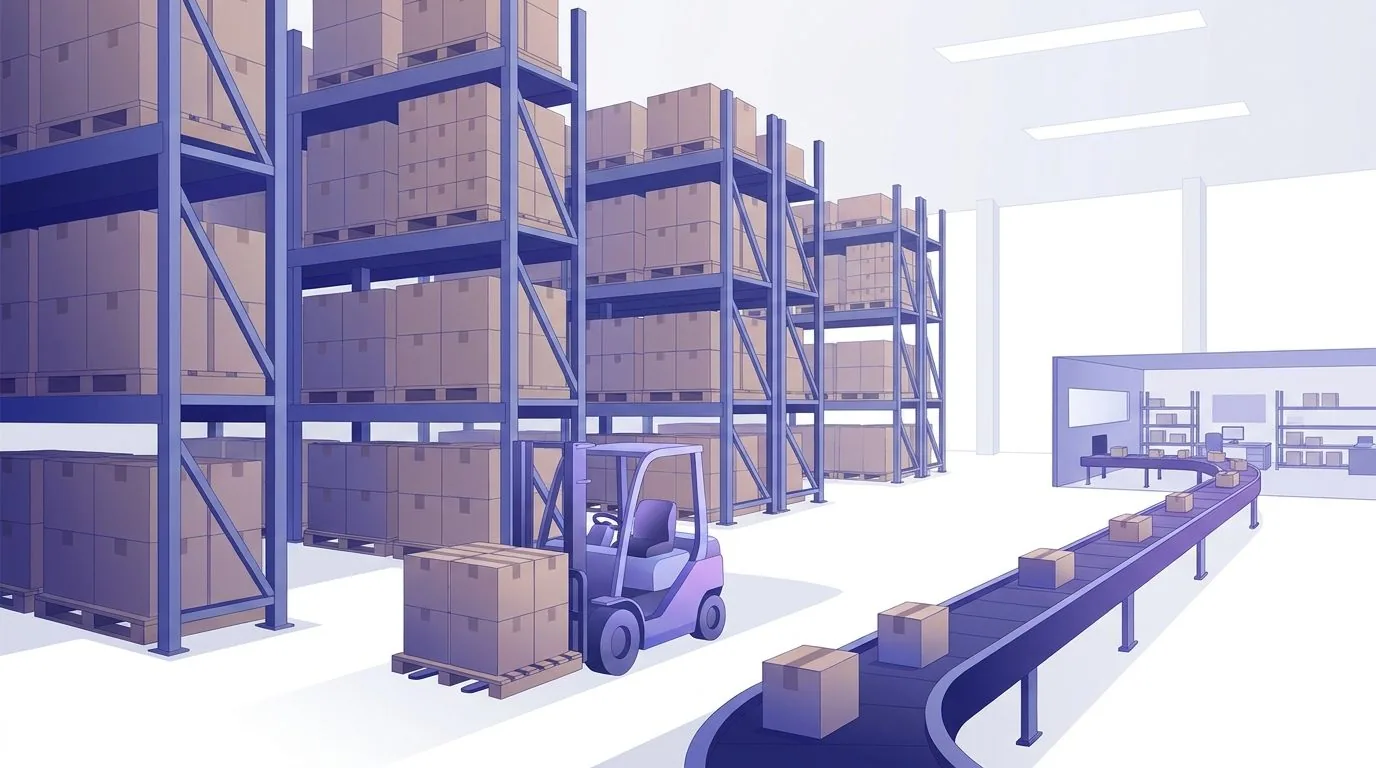
- Amazon AWD is bulk storage that sits in front of the FBA network. Since 20 August 2026 it has been available in Germany, France, Italy, Spain and the UK.
- You pay a flat storage fee that does not depend on how long stock stays, plus inbound and outbound processing and transport to FBA. Storage fees are waived from 1 October to 31 December 2026.
- In Europe, AWD only supplies the FBA network at launch. Other sales channels, self-service removals and all products are not covered, so check your SKUs one by one.
What is Amazon AWD?
AWD stands for Amazon Warehousing and Distribution. It is a bulk storage service that sits in front of the actual FBA network. You send your goods in cartons or on pallets to an AWD distribution centre. They stay there as reserve stock, and Amazon moves them into the fulfilment centres your orders ship from.
The difference from FBA is easy to explain. FBA is the warehouse you sell from: stock is ready to pick, pack and ship. AWD is the warehouse before that. Nothing ships to customers from AWD; it only replenishes FBA. Think of AWD as the buffer warehouse you would otherwise run yourself or rent from a logistics provider.
For many sellers that buffer is the problem. Goods from Asia arrive in large shipments, but FBA only accepts as much as your storage capacity allows. The rest has to sit somewhere and go to Amazon later in smaller shipments. AWD is meant to bring that intermediate step into Amazon's own network.
AWD in Germany and Europe: since when and where
Amazon has offered AWD in the US since 2022. The service came to Europe on 20 August 2026 and launched at the same time in Germany, France, Italy, Spain and the United Kingdom.
Amazon describes the service with a few core points: extra storage capacity, so you can send more stock without being limited by FBA capacity constraints. Automatic replenishment to FBA fulfilment centres across Europe. A flat storage price regardless of how long goods stay, with no long-term commitment. And discounts on storage and transport costs when you combine AWD with other eligible Amazon services.
Amazon decides which distribution centre your stock goes to. Which FBA sites exist in Germany is covered in our list of Amazon fulfilment centres in Germany. Amazon does not publish a comparable list for AWD. You see the destination when you create the shipment.
Automate it with SellercoreStorage Optimizer: Never out of stock, no dead capital Learn moreHow AWD works: from container to FBA warehouse
The process has three stages. First, you create a shipment to AWD in Seller Central under Amazon Warehousing and Distribution. Amazon checks whether your items are eligible for AWD at this point. Then you deliver the goods to the assigned distribution centre, where they are received and held as AWD inventory, separate from your sellable FBA inventory.
In the third stage the goods move on. Amazon automatically replenishes your FBA stock from AWD based on demand. You can also create AWD-to-FBA replenishment shipments yourself, for example before a sales event. Only once the goods are received at the FBA warehouse are they available to customers.
This matters for your planning: there is still a transport step between AWD and the sale. Stock in AWD or on its way to FBA is not sellable stock. If you have only watched the FBA number in Seller Central so far, you now need to track three stages: AWD, in transit and sellable.
With AWD you still need to deliver goods so they can move on to FBA later without rework. Sort out labels, packaging and carton requirements before your first shipment. Our guide to the Amazon FBA prep center explains what that involves.
AWD vs FBA: the differences at a glance
AWD does not replace FBA; it complements it. So the real question is not AWD or FBA, but how much of your reserve stock you keep with Amazon instead of in your own or a third-party warehouse. The key differences:
- 1Purpose
FBA stores stock that is being sold and ships to customers. AWD stores reserve stock and only ships to FBA.
- 2Storage fee
FBA charges monthly by volume, more in the fourth quarter, with surcharges for stock that sits too long. AWD quotes a flat price that does not depend on storage duration.
- 3Capacity
FBA is capped by your capacity limit. AWD is meant to give you storage beyond that.
- 4Availability to customers
FBA stock is sellable right away. AWD stock first has to be moved to and received at an FBA warehouse.
- 5Extra costs
With FBA you pay the inbound shipment to Amazon yourself. With AWD, inbound and outbound processing and transport from AWD to FBA come on top.
How much does Amazon AWD cost?
Amazon bills AWD in three blocks. First, the storage fee, which according to the programme policy is charged monthly based on daily cubic volume. Second, processing fees for inbound and outbound handling. Third, the transport fee when stock is moved from AWD to an FBA fulfilment centre.
We deliberately do not quote specific rates here. Amazon publishes the current AWD fees in Seller Central, and they can change. For your decision, the price per cubic metre matters less than the total per unit sold. Add up all three blocks and compare them with what your current setup costs: your own warehouse or a provider, plus the smaller shipments you use to replenish FBA today.
Do not forget the FBA side. Stock replenished from AWD then sits in the FBA warehouse and incurs the normal storage fees there. How those are made up and why the fourth quarter costs more is explained in our overview of FBA fees. AWD pays off when it helps you keep less, faster-moving stock in FBA.
Amazon waives AWD storage fees for eligible inventory in its European AWD distribution centres from 1 October to 31 December 2026, as stated in the Seller Central announcement. Inbound processing, outbound processing and transport fees still apply at standard rates. Storage fees resume on 1 January 2027.
AWD and your FBA storage capacity
The strongest argument for AWD is capacity. How much you may send to FBA depends among other things on your Inventory Performance Index and your sales velocity. Sellers who regularly hit the limit have to store large deliveries elsewhere and send them on in stages.
AWD shifts that problem. The reserve sits with Amazon, and Amazon replenishes FBA when there is space and demand. The FBA limit does not disappear. Only what fits into FBA is sellable. But you save the detour through a third warehouse and the manual planning of split shipments.
At the same time, do not use AWD as an excuse for slow sell-through. Stock that does not move does not get better in a cheaper warehouse. It ties up capital, and once it reaches FBA it weighs on your IPI again. AWD is worth it for predictable reserve stock, not for slow movers. For seasonal peaks, our seasonal calendar shows how much lead time FBA inbound needs.
Limits of AWD in Europe
At its European launch, AWD is leaner than in the US. Before you plan larger volumes, you should know these points:
- 1FBA network only
In the US, AWD can also supply other sales channels. In Europe, the service only replenishes your FBA warehouses at launch. If you also supply your own shop from the same stock, you still need another warehouse for that.
- 2No self-service removals
In the EU and UK you cannot pull stock out of AWD yourself. You have to contact Selling Partner Support, provide an eligible return address and pay any applicable return charges.
- 3Not every product
Amazon only accepts eligible inventory in large quantities. Whether an item qualifies is shown when you create the shipment. Do not plan to move your whole warehouse at once.
- 4One more transport step
Every unit passes through Amazon's network one extra time. That costs processing and transport and adds time before stock is sellable.
VAT: where your stock sits matters
Storage in the EU always has a tax side. If your stock sits in a country where you are not registered for VAT, that can trigger a registration there. You may know this from the Pan-European FBA programme. AWD is no different: what counts is where the stock physically is.
So check which country the goods are going to when you create the shipment, and clarify the consequences with your tax adviser before storing larger volumes. Why storage location matters so much for VAT is explained in our guide to Amazon VAT and OSS.
Who AWD is worth it for and who should skip it
AWD suits sellers who buy in large volumes, for example by sea freight, and currently use their own warehouse or a provider as a buffer in front of FBA. Sellers who regularly hit their FBA capacity limit or have strong seasonal peaks can also benefit: the stock is already inside Amazon's network when demand rises.
AWD makes less sense if your volumes are small and a direct shipment to FBA is enough. The same applies if you serve several channels from the same stock, because that is not possible in Europe at launch. And if you often need stock back, for rework or to sell elsewhere, the missing self-service removal will slow you down.
A good way in is a test with a few predictable items. Pick products with steady sell-through and a healthy margin, keep an external reserve and compare after a few weeks: how long does the trip from AWD to FBA take, how often were you out of stock, and what does a unit really cost you in the end?
Your first AWD shipment in five steps
If you want to try AWD, this order works best:
- 11. Choose items
Pick a few SKUs with steady sales and enough volume for a bulk shipment to be worth it.
- 22. Check eligibility
Create a shipment in Seller Central under Amazon Warehousing and Distribution. Amazon shows you which items are accepted.
- 33. Compare costs
Work out storage, processing and transport per unit and compare with your current setup. Use the current fees from Seller Central.
- 44. Prepare the goods
Sort out labels, packaging and carton requirements so the stock can move on to FBA later without rework.
- 55. Watch replenishment
Track when Amazon replenishes from AWD and how long receiving takes. Create your own replenishment shipments when needed.
Planning inventory when two warehouses are involved
AWD does not make inventory planning simpler, it makes it more precise. Instead of one number you have several: stock at the supplier, stock in AWD, stock in transit and sellable FBA stock. What matters is how many days your sellable stock will last and when you need to reorder from your supplier so the next delivery arrives in time.
That is exactly what Sellercore inventory management is built for. The Storage Optimizer calculates days of cover per SKU from your last 90 days of sales, seasonality, stock in transit and your supplier's lead time. From that it derives the reorder point, and you get purchase order suggestions per supplier. So you see early whether your reserve is enough, whether it sits with you, with a provider or with Amazon.
You can test Sellercore for 14 days with all features and look at your own numbers before you plan your first AWD shipment.
Conclusion
Amazon AWD brings the buffer warehouse in front of FBA into Amazon's own network. Since August 2026 this has been possible in Germany and four other European markets. The service is mainly interesting for sellers who buy in large volumes, hit FBA capacity limits or need to absorb seasonal peaks.
Before you start, check three things: whether your items are eligible, what a unit costs you including processing and transport, and what tax consequences the storage location has. AWD storage fees are waived until the end of 2026, which makes this a good window for a test with a few SKUs.
Frequently asked questions
What is the difference between Amazon AWD and FBA?
FBA is the warehouse Amazon ships to your customers from. AWD is bulk storage in front of it: your reserve stock sits there, and Amazon uses it to replenish your FBA warehouses. Customers are never supplied directly from AWD.
When did Amazon AWD launch in Europe?
Amazon launched AWD in Europe on 20 August 2026, in Germany, France, Italy, Spain and the United Kingdom at the same time. In the US the service has existed since 2022.
How much does Amazon AWD cost?
There are three fee blocks: a flat storage fee by volume that does not depend on storage duration, processing fees for inbound and outbound handling, and a transport fee from AWD to FBA. Current rates are in Seller Central. From 1 October to 31 December 2026 Amazon waives the storage fee for eligible inventory.
Can I use AWD to supply my own online shop?
Not in Europe. At launch, AWD here only supplies the FBA network. Supplying other sales channels is so far only available in the US.
Does AWD inventory count against my FBA storage capacity?
Amazon explicitly positions AWD as extra storage capacity that lets you send more stock without being limited by FBA capacity constraints. But only stock in FBA is sellable, and your limit still applies there.
Did this article help? Mark Sellercore as a preferred source on Google to see our articles more often in search results.
Add Sellercore as a preferred source on Google


Try Sellercore free for 14 days.
No credit card, connected to Amazon in a few minutes.